


Research

Daily blood pressure checks following birth could protect women after common pregnancy issue
Published:

Published:
Checking blood pressure daily at home could cut the risk of a future heart attack or stroke for new mothers who had high blood pressure during pregnancy, based on a study funded by us and published in the journal Hypertension.
Women who self-monitored their blood pressure in the weeks after giving birth, allowing doctors to regularly increase their blood pressure medication if necessary, ended up with better functioning arteries, the research led by the University of Oxford found.
Reduce the risk of heart attack or stroke
When medications were tailored to people’s daily blood pressure changes, their arteries were less stiff at the end of the study - a change researchers estimate could reduce the risk of heart attack or stroke by 10 per cent.
Around one in 10 women develop high blood pressure during pregnancy, which is called a ‘hypertensive pregnancy’. It is a key problem for people who have the pregnancy complication pre-eclampsia. High blood pressure in pregnancy can affect women who have never had high blood pressure before.
Even though women’s blood pressure usually falls back to its pre-pregnancy level after several weeks, there is evidence that, for some, their arteries remain stiffer for many years after the pregnancy.
This matters because people with stiffer arteries are more likely to develop high blood pressure again later in life, which can lead to a heart attack or stroke.
The new study set out to investigate whether women checking their own blood pressure at home in the weeks after giving birth could be better protected from stiff arteries.
Researchers recruited 220 women with hypertensive pregnancies from the Women’s Centre at Oxford University Hospitals Foundation Trust. All were taking blood pressure medications after giving birth, which would be gradually reduced and stopped. However about half of the women had their medication reduced based on only a few blood pressure readings, These 108 women received the usual medical care, which typically involves three blood pressure checks in the eight weeks after giving birth.
Better blood pressure control
The remaining 112 women checked their blood pressure daily in the weeks after giving birth, entering the results into an app shared with medical professionals – who could then change their medications day-to-day if needed, potentially providing better blood pressure control.
The women checking their blood pressure at home ended up having much better blood pressure control during the first weeks after giving birth.
To see if women benefited from this better early blood pressure control, the researchers later examined a range of different heart and blood pressure measurements. In particular, they looked at the stiffness of the women’s arteries six to nine months after giving birth, using a measure called ‘pulse wave velocity’.
Pulse wave velocity is measured by attaching a blood pressure cuff to someone’s arm and a cuff to their thigh, and measuring how long it takes their pulse to travel that distance.
When the arteries are stiffer, they do not cushion the pulse and reduce its speed, so the pulse travels faster.
Women who regularly self-monitored their blood pressure in the early weeks after pregnancy had significantly less stiff arteries, based on their pulse wave velocity. Their pulse travelled 70 centimetres per second (0.7 metres per second) more slowly than those given the usual medical care.
10 per cent lower risk
The researchers say a one metre per second slower pulse is equivalent to an approximately 15 per cent reduced risk of having a heart attack or stroke. This would mean an estimated 10 per cent lower risk of a heart attack or stroke for the women doing the daily blood pressure checks.
Heart attacks and strokes are known to be more common in women who have had a hypertensive pregnancy. Stiffer arteries after a hypertensive pregnancy mean the body has to force blood through the less flexible blood vessels. Higher blood pressure can then damage the lining of blood vessels, leading to a build-up of fatty material in the damaged area. That fatty build-up can eventually block the vessel and trigger a heart attack, if it blocks blood flow to the heart, or a stroke, if it blocks blood flow to the brain.
It is not possible to predict whether women from this study will go on to have a heart attack or stroke without studying the women who participated for longer, but researchers also found those who checked their blood pressure regularly continued to have significantly lower blood pressure during the first year after pregnancy.
Further trials are now underway to test different ways of rolling out blood pressure self‑monitoring for women after a hypertensive pregnancy, including whether specialist NHS clinics could deliver this care.
"Protect women’s heart health"
Dr Sonya Babu-Narayan, our Clinical Director, said:
“The study results shine a light on a crucial window after birth, when paying close attention to blood pressure could help protect women’s heart health for years to come. Empowering new mothers to check their blood pressure conveniently at home allows blood pressure medication to be better tailored to their needs.
“We now look forward to seeing results from larger studies with longer follow-up to see how this might save women’s lives. Research like this highlights the significance of the recently renewed women's health strategy, reflecting the importance of heart health advice and care at key points across a woman’s life, from periods and pregnancy to menopause and beyond.”
Professor Paul Leeson, Professor of Cardiovascular Medicine the University of Oxford, said:
“Our findings suggest that the weeks after birth offer a powerful and often overlooked opportunity to protect a woman’s future heart health. By simply monitoring blood pressure at home, new mothers with hypertensive pregnancies can protect their bodies from future damage. We hope our work will pave the way for wider use of home monitoring, so more women across the UK can benefit.”
Protecting women’s hearts after pregnancy: how research made a difference for Becki
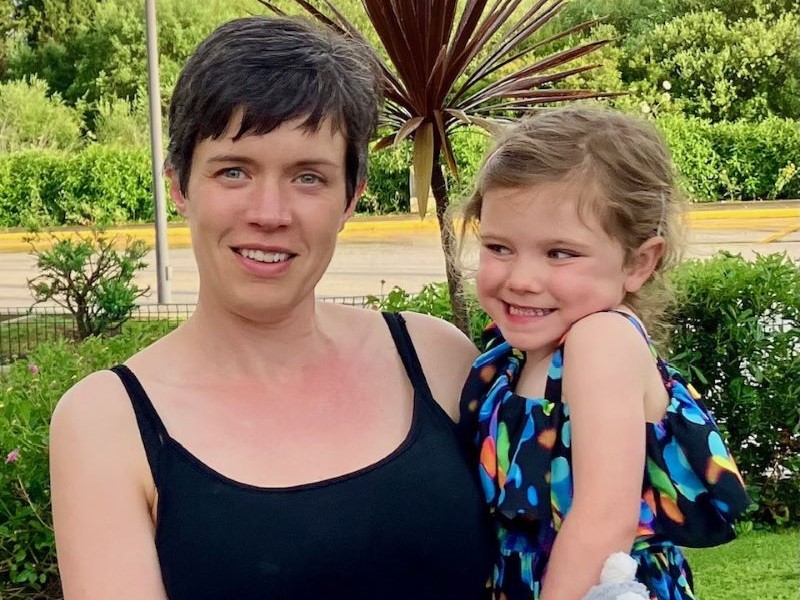
When Becki Ellsmore, from Didcot in Oxfordshire, learned she was having a baby in 2020, she expected to “sail through” her pregnancy. But a few months later, a routine medical check showed her blood pressure was worryingly high and she needed to be put on medication. A few days after giving birth, Becki signed up to the study led by Professor Paul Leeson at the University of Oxford and began to take daily blood pressure readings.
Becki was one of 112 women in the study who measured their blood pressure daily at home. She entered her readings into an app shared with healthcare professionals which allowed doctors to adjust her medication day by day if needed, helping to keep her blood pressure more tightly controlled.
The rest of the 108 women received standard care, which usually involves around three blood pressure checks in the first eight weeks after giving birth.
She said: “Even amid the chaos of life with a newborn baby, it was relatively simple to take a few minutes each day to check my blood pressure.
“When my blood pressure readings changed, the researchers could quickly react and pass that information to my GP.
"It was a shock"
“I’ve never had any health problems before, and I’d had no symptoms at all. So it was a shock when the doctors told me my blood pressure was skyrocketing, and then when I was hospitalised shortly before my daughter Remi was born in March 2021 as I’d developed pre-eclampsia.
“Before I had Remi I didn’t know much about high blood pressure or pre-eclampsia. Having read up about the long-term effects, it’s really scary, but hopefully being part of this study will have helped to reduce my risk of any further problems.
"I was definitely motivated by Remi. If she chooses to have a baby one day, she could end up having the same kinds of problems, but hopefully by then we’ll know much more about how to care for women with pre-eclampsia. I hope this study will lead to more women being taken care of the way I was.”
Significantly better blood pressure
As a result of her medication being changed according to her daily readings, Becki had significantly better blood pressure control in the first weeks after giving birth.
Three years later, Becki, who works in marketing, says the study has had a lasting impact on how she manages her health.
She said: “I still have my blood pressure monitor at home, I stay active, and I know when I need to reset things a bit. Being part of this research has empowered me because I was able to be closely monitored by a medical professional who put so much effort into keeping my blood pressure in a sensible place after I gave birth, and I need to continue that commitment to staying healthy. I honestly don’t know where I’d be now if I hadn’t taken part, I might have had to be on medication long‑term. Instead, I feel like I’ve invested in my future health.
“Having to go to the GP for things like a blood pressure reading would be a massive hassle as a new mum, and I think we all enjoy having the convenience of doing things ourselves at home with our kids. I felt like I had the power to take control of my health. When Remi was younger, she would grab something, try and make a tube out of it and pretend that she was taking her own blood pressure, so she's grown up knowing that I need to take care of my heart.”